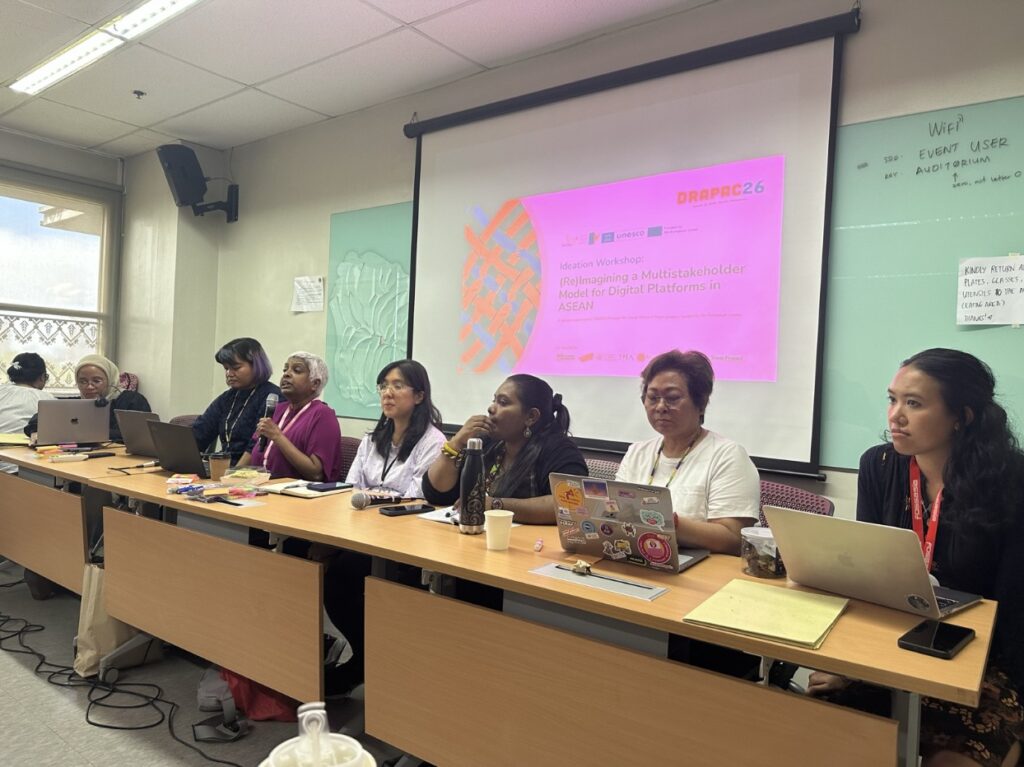
MANILA, PHILIPPINES – Addressing the rapid expansion of top-down digital platform regulations across Southeast Asia, a coalition of regional civil society organisations (CSOs) successfully concluded a strategic dialogue at the Digital Rights Asia-Pacific Assembly (DRAPAC 2026). The session, titled “(Re)Imagining a Multistakeholder Model for Digital Platforms in ASEAN,” served as a decisive step toward turning regional guidelines into practical, rights-based accountability frameworks.
The convening of this session is a continuation of discussions that Civil Society Organisations (CSOs) in the region have been holding in recent years. The first convening started in 2025 at DRAPAC Kuala Lumpur. To keep this regional momentum going, Indonesia’s Damai Coalition along with network of Southeast Asian CSOs initiated this year’s discussion with UNESCO’s support, through the Social Media 4 Peace (SM4P) project funded by the European Union. The workshop directly advanced the ongoing implementation of the ASEAN Guidelines for the Governance of Digital Platforms. This initiative bridges international groundwork and localised, actionable national strategies, such as Indonesia’s Damai Coalition and Malaysia’s internet safety models.
Unlike traditional policy panels, this participative session actively engaged intergovernmental bodies, major tech platforms, academia, and civil society to co-create an inclusive, transparent, and survivor-centric governance model that balances public safety with freedom of expression.
The multistakeholder dialogue and strategic exercises conducted during the session yielded significant progress in defining concrete steps toward regional platform accountability. The workshop successfully brought together 60 key stakeholders from 11 ASEAN member states, including civil society advocates, academics, regional bodies, and major global tech platforms. This cross-sectoral attendance opened a rare space for open discussions regarding structural gaps in current content moderation, particularly on critical yet often overlooked issues like technology-facilitated gender-based violence (TFGBV) and hate speech against marginalised groups, including persons with disabilities.
“Civil society must be placed at the center of this multi-stakeholder dialogue on platform governance. It cannot be effective or rights-respecting without the ground-level expertise of CSOs, who ensure that policy frameworks directly protect marginalized communities rather than serve top-down state or corporate interests”, says Nenden Arum, SAFEnet Executive Director.
The primary output of the session was the co-creation of a baseline policy framework to guide the local implementation of the ASEAN Guidelines for the Governance of Digital Platforms. Participants strongly reached a consensus that future digital governance must shift away from unilateral government over-regulation and insufficient platform self-regulation. Instead, the session laid the groundwork for a co-regulatory model that is inclusive, transparent, and strictly survivor-centric. To solidify this momentum, the stakeholders in attendance concluded the workshop by committing to developing a shared regional roadmap to demand transparency and equitable power distribution in digital spaces.
The outputs and frameworks generated during this DRAPAC 2026 session will serve as a foundational roadmap for civil society advocacy and policy engagements across the region. The coalition will continue to work closely with UNESCO and regional stakeholders to ensure that platform governance in Southeast Asia prioritises transparency, distributes power equally, and firmly safeguards human rights in the digital sphere.
About UNESCO’s Social Media 4 Peace
Social Media 4 Peace (SM4P) is a global initiative implemented by UNESCO to build societies’ resilience to online harmful content, including disinformation and hate speech, while safeguarding freedom of expression and fostering peace through social media.
Co-Organizer
- Centre for Independent Journalism (CIJ)
- ARTICLE 19
- Foundation for Media Alternatives (FMA)
- Yayasan Tifa
- EngageMedia
- Southeast Asia Freedom of Expression Network (SAFEnet)
- Sinar Project